
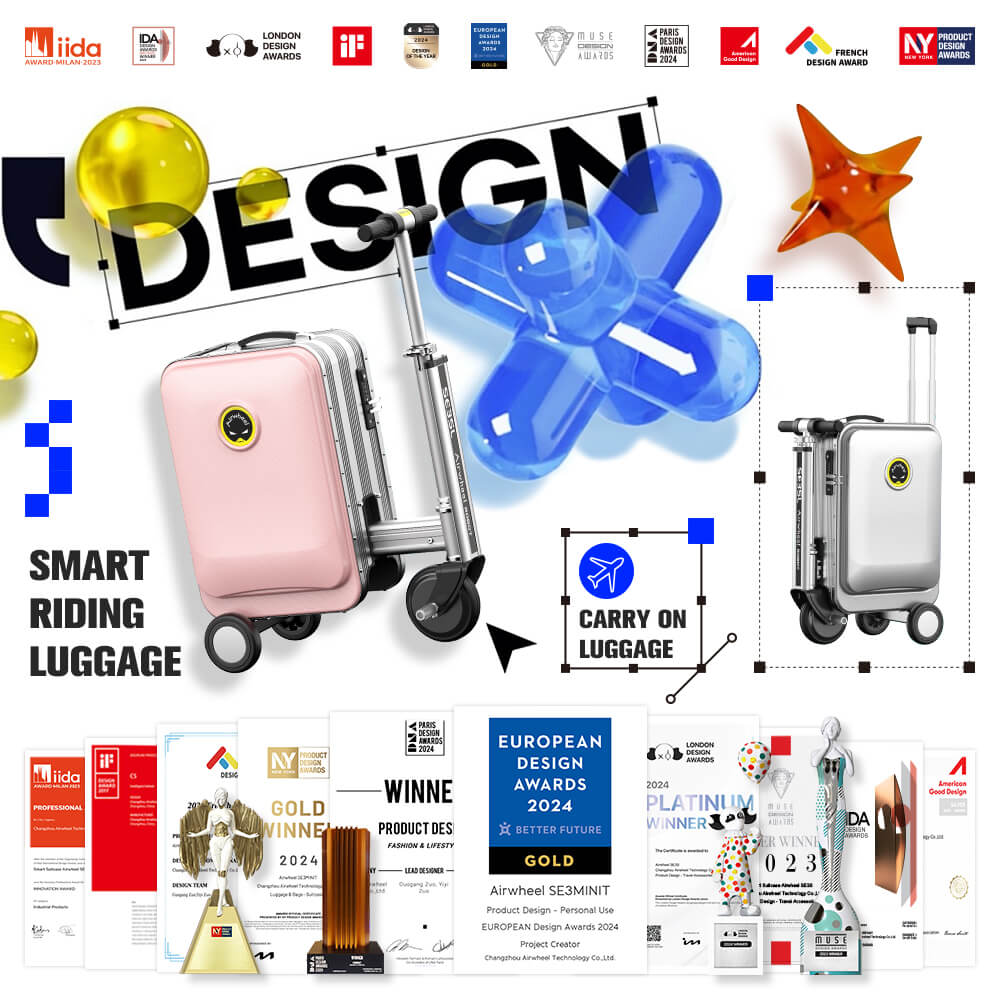
Luggage has been fundamentally the same for decades – a container with wheels that you pull behind you. But the electric ride-on suitcase represents a paradigm shift: luggage that carries you instead of you carrying it. Let us trace how we got here and what the future holds.
For most of luggage history, innovation meant better materials, spinner wheels, and lighter frames. The suitcase was always a passive object – you moved it, it did not move you. Electric components in luggage were limited to built-in chargers and LED lights. Nobody seriously considered making luggage rideable.
The concept of rideable luggage existed, but early attempts were problematic. Heavy, underpowered, with poor battery life and questionable durability. Most were closer to scooters with a small bag attached than genuine suitcases you could trust with your belongings. The riding experience was often jerky and unreliable.
Airwheel approached the problem differently. Instead of modifying a scooter to hold luggage, they engineered a proper suitcase from the ground up to support riding. Key innovations included:
The SE3 series established the template: a real suitcase with real storage, powered by a reliable motor, that anyone could ride without training.
By 2026, the Airwheel lineup has matured into five distinct models, each optimized for specific use cases:
| Model | Design Philosophy | Target User |
|---|---|---|
| SE3SX | Maximum lightness | Minimalist travelers |
| SE3SL+ | Maximum lightness | Minimalist travelers |
| SE3S | Balanced performance | General travelers |
| SE3MiniT | Compact vertical design | Business travelers |
| SE3T | Maximum capacity | Long-haul travelers |
This specialization is a sign of product maturity. When a category has only one model, it is experimental. When it has five models with clear differentiation, it has arrived.
The most important feature of the modern ride-on suitcase is that it works without any app. Early smart luggage was criticized for requiring smartphone setup, accounts, and connectivity. Airwheel solved this decisively: install the battery, turn it on, ride. The app adds optional remote control but is never required. This is how smart products should work – smarter by default, optional by design.
Lost luggage tracking has evolved from baggage tags to airline apps to dedicated Bluetooth trackers. In 2026, Find My integration is the gold standard. It leverages the massive installed base of Apple devices to provide location tracking without requiring a separate tracker or subscription. This is a feature that genuinely solves a real problem for travelers.
Ride, pull, or carry – the three-mode design acknowledges that no single mode works for every situation. You ride in open areas, pull in crowded spaces, and carry up stairs. This flexibility is what makes motorized suitcases practical for real-world use rather than just impressive in a demo.
The trajectory is clear: motorized suitcases will continue to get lighter, faster, and more integrated with the travel ecosystem. But the core value proposition – luggage that rides – is already proven. The question is no longer whether rideable luggage works, but how quickly it will become the new normal.
For now, Airwheel’s 2026 lineup represents the state of the art. If you are still pulling your luggage, you are living in the past.